Wednesday, September 02, 2009
District 9

IMDB: 8.6
Rottentomatoes: 89%
Like a dog waiting for table scraps (except that the dog is also the chef), South Africa finally got the opportunity to see District 9 when it opened in theaters on the 28th of August, but, mainly due to illness, I was only able to see it the following Tuesday.
I tried going in with no expectations, for I would hate myself if I let hype ruin it. I think it's safe to say I was successful, as I loved the film. South African viewers, most of whom will have lived first-hand through Apartheid (or at least its legacy), and xenophobic violence will react differently to those in the US. We will invariably feel stronger connections to the events depicted in the film, and by the same token have less tolerance for improper treatment of such subject matter. With this in mind, I felt that the political allegory was clear, but never heavy-handed.
The protagonist, Wikus van der Merwe, was the biggest surprise for me. The character seems to have had a great deal of time spent on his development during the writing phase, but this is simply not true. Amazingly, the majority of his dialogue and actions were improvised, and his development occurred on camera. This is mainly thanks to the previously unknown talent of Sharlto Copley, a first-time actor who creates possibly the most emotionally engaging action hero (and I use the term loosely here) in decades. Taking Wikus from nerdy middle-management bureaucrat to saviour of an entire race, Copley goes through a whole range of emotions. He's simultaneously the film's emotional gravitas, action hero, and comic relief. Wikus is ultimately a character who, despite winning the affection of the audience, is not entirely likeable, which makes him very real indeed.
With Weta being involved, it's needless to say that the effects are amazing, but it certainly helps that you have a director with a background in special effects who knows how to set up a shot in order to get the most bang for buck. It is in the aliens themselves where this expert utilization of modern visual effects is most striking. These aliens aren't Star Trek's humans with scant prosthetics; District 9's "prawns" are possibly the most alien looking aliens ever put on film. The fact that these inhuman monsters become truly emotionally captivating speaks well of the director's ability to manipulate the viewer's emotion and steer it in the direction of his choice. It also validates the film's underlying message that, due to mankind's inherent flaws, even creatures such as these can be more human than humans themselves.
Despite following an inflexible application of Joseph Campbell's monomyth, the story kept me guessing until the end. I'm not sure if the ambiguous ending is purely to leave room for a sequel, or if it is meant to engage contemplation in the viewer, but it does both. Long after the credits rolled I found myself thinking about the questions that the film raised, and that is a trait which elevates a good science-fiction film into a great one.
Number of F-bombs: 137.
Blog update
The astute eye might catch a slight change in the layout and theme of the blog. Naturally, you may have some questions. Let me throw you a bone:
What was wrong with the old theme?
A few things. Mainly that the light on dark became increasingly difficult to read. I also decided that the old theme was extremely kitsch; whenever I'd visit the blog, I'd feel as though I'm on the personal webpage of the world's biggest asshole. Now, I realise that I may in fact be the world's biggest asshole, but I don't want to be reminded of it everytime I read my own blog.
Why the minimal look? Is it 1994 all over again?
A simple layout is quick to load, quick to render, and ultimately doesn't distract from the content (because I'll let nothing diminish my classy content!). Remember, designers: the medium is not the message, the message is the fucking message.
Why the big font?
Oh, come on. It's not that big! Besides, I have bad eyes and a monitor that's not tiny - 17" isn't exactly huge by today's standards, but it displays the site adequately.
Does this mean you'll be updating content more frequently?
Ha! Don't bet on it! Seriously though, I hope to... But no, really, don't bet on it.
What happened to the Eve Online ads?
I've stopped playing that game a long time ago, so I don't even know why I still had the ad up. Oh yeah, because I'm greedy. Well, the ad looked okay on the old layout, but it's ugly and distracting on Convergence 2.0, so I got rid of it. The only ads you'll find now are unintrusive Google text ads. Well, they're not that unintrusive, but you won't wake up one night to find them standing at the end of your bed or anything. Anyway, I still think EVE Online is a great game and I hope to get back into it when time permits.
What's with the Reddit links on the sidebar? I thought you were into Digg. Did you cross over to the dark side?
Actually, after joining Reddit about a year ago I realised that I had been on the dark side all along. I lost almost all interest in Digg and never looked back, so when Digg banned my account a few months ago for unknown reasons (read: trolling), I didn't even care. Like all of the cruft on the sidebar, the Reddit links may move or disappear altogether, so they may not even be there anymore when you read this.
Happy reading, and drop me a line if you need to.
Thursday, June 04, 2009
Russel's Paradox over morning tea
The following is an unfinished post I found gathering dust in my drafts folder. I'm too lazy to finish it, it's too interesting to delete, and leaving it to fester just seems wrong so I'm posting it in its unpolished, incomplete form. Maybe it'll be interesting to someone.
This morning, as I settled with some tea to check my RSS feed collection with Netvibes, I noticed that a recent Dictionary.com Word of the Day was circumlocution. I found this to be rather delightful, as I've always been a fan of the word.
I first happened upon the word in the midst of some forgotten book which I read in my teens. Upon reading its definition - The use of many words to express an idea that might be expressed by few - I found it endlessly charming that the word circumlocution itself is, in fact, an example of the opposite of what it describes; that is to say, it is an example of using one word to express an idea that would otherwise require the use of many. Lexically speaking, circumlocution is an example of its own antonym. For the sake of clarity, that antonym could be taken to be conciseness or terseness.
I became an instant fan of the word, not least of all because of its scholarly Latin character and elegantly flowing phonetic quality. Much to the chagrin of anyone unfortunate enough to be in my company, I'd attempt to use it in casual conversation as often (and sometimes, it would seem, as inappropriately) as possible.
In other news, I'm possibly the most humdrum person you'll ever meet.
I'm fascinated by the concept of self-reference
These words are not autantonyms (also known as Janus words). Autantonyms are homographs with inherently incompatible binary definitions or, more strictly, polysemes. All this befuddling lingo-babble just means that autantonyms are words that have more than one meaning, and two of those meanings happen to be opposites. The word "fast", for example, can mean "quick", but also "fixed in place" - which is the reverse of the former definition. For our purposes, our words are, from a completely self-referential perspective, themselves examples of their own antonyms. Autological words are words which describe themselves. Heterological words are words which do not describe themselves. There is, as far as I am aware, no term for words which strictly describe the opposite of itself. Or, as stated above more clearly, examples of their own antonym. For the sake of convenience, I shall coin these antautological words. The distinction between heterological words and antautological words is subtle, but important.
The word "abbreviation", for example, means "reduction" or "shortening". With the average length of a word in the English language being approximately five letters, it's safe to say that "abbreviation, weighing in at a comparatively marathon twelve letters, is clearly a long word.
You have two sets, "words which are examples of their own antonyms" and "words which are not examples of their own antonyms" (Set A and Set B respectively).
Set A contains words like "abbreviation" (for the sake of convenience we'll say that at twelve letters it falls outside our objective criteria for a "short" word).
The Grelling-Nelson paradox holds for contrautological words. If "contrautological" is an autological word, it applies to itself. The paradox is introduced. If "contrautological" is a contrautological word, then - by its definition - it must be an autological word. The paradox is again introduced. Is "contrautological" both a contrautological and an autological word at the same time? Think it over after getting some sleep.
Wednesday, June 03, 2009
10,000 BC
IMDB score as of 2009-06-03: 4.9/10
Rotten Tomatoes rating: 9%
I had the misfortune of seeing this turkey a second time on television the other night. I say "a second time" because... Well, actually it makes me depressed thinking about the money I wasted when I originally went to see this pile at the cinema, so let's just forget about that and get on with the review:
Imagine the rare circumstance where being historically and scientifically accurate would actually deliver a highly entertaining, immersive and universally enjoyable film. Now picture Roland Emmerich gently placing both historical accuracy and entertainment value into an ornate clay bowl, dropping his trousers, and taking a steaming, fat shit all over these twin pillars of cinematic value, all whilst twirling his mustache and laughing maniacally. This is 10,000 BC.
I cringe in horror at the thought that this man will be helming an adaptation of Isaac Asimov's Foundation.
Monday, November 17, 2008
The Oscars: Who Cares?
Producer Sid Ganis is the current president of the Academy of Motion Picture Arts and Sciences. He has produced such timeless classics as: ( Rotten Tomatoes rating in brackets)
- Big Daddy (40%)
- Deuce Bigalow: Male Gigolo (24%)
- Mr. Deeds (22%)
- The Master of Disguise (2%)
Friday, October 24, 2008
Good Old Games

GOG.com is now officially out of private beta and available to the public.
Good Old Games is a website which allows you to download classic games ("classic" as in Fallout 2, not as in Pong) legally and completely DRM free for around six bucks a pop.
The lack of DRM means that you actually own the game once you download it, and you're free to install it on as many different machines as many times as you like, and even download the game from GOG as many times as you wish after paying only once.
The games are all guaranteed to be perfectly compatible with both Windows XP and Vista - which eliminates a huge headache when it comes to older games - and also include full technical support. Furthermore, a bunch of extra freebies are thrown in, such as wallpapers, full soundtracks, complete manuals, etc.
Earthworm Jim 1 & 2, Colin McRae Rally 2005, and the epic Freespace series are examples of titles available for six to ten dollars each.
My personal opinion is that, for the price of a nice lunch, it's a steal. Being a broke motherfucker really isn't an excuse to pirate these games anymore, and considering the service and extras you'd be missing out on, you'd just be doing yourself in.
Saturday, October 18, 2008
Robocop on a Unicorn
The image above is part of a nice Flickr gallery I found featuring images of Robocop on a unicorn. Yup, that pretty much covers it.
Okay, so in the above picture Robocop isn't strictly on the unicorn, but I think Robocop's orientation towards unicorns is really more of a guideline than a rule.

Okay, so in the above picture Robocop isn't strictly on the unicorn, but I think Robocop's orientation towards unicorns is really more of a guideline than a rule.
Friday, October 03, 2008
Hyperopia
After months of weighing the relative pros and cons since I first began to notice an increase in both the frequency and intensity of my headaches - from occasional to downright chronic - I find myself in the optometrist's office. I was referred by my doctor after he had heard me whine about excruciating brain-pain and the fear of tumors once too often. Owing to my inherent laziness and indecision, it's taken me long.

The examination room is clean but not threateningly sterile and the optometrist is petite, soft-spoken, and oh-so-pretty. The final quality making it somewhat difficult to focus on arbitrary points on the wall when instructed to do so, and not her shapely bosom.
Finally after being strapped into the terrifying phoropter and reading aloud ostensibly random shapes, symbols, digits and letters in varying light conditions, the lenses are removed. A blur which is very familiar, despite the fact that I had never before noticed it, returns to my vision to steal the crispness from the world around me.
It turns out I have Hyperopia - farsightedness. In addition to this my left eye is apparently somewhat weaker than my right and I'm getting a pair of glasses. I'm to collect them in a week.
Wednesday, October 01, 2008
How will you fix the economy?
"Our economy and putting it back on the side of the public trust. And that contract that should be inherent in corporations who are hell bent on destroying America and American troops are providing in his country. But no, the Pakistani people also, they want freedom. They want democratic values to be able to speak with him the other day and giving him my commitment, as John McCain's running mate, the first thing I said to him was, if you ask that question until somebody answers for me what is it exactly that the lobbyists play in an issue that we see right now in Washington and that is strong and that important an issue that we saw with that invasion of Georgia shows us some steps backwards that Russia has recently taken away from the other day and giving him my commitment, as John McCain's running mate, the first thing I said to him was, if you really think I can give you examples of things that John McCain and I have not and I have understood the world is and how important it is about doing a lot of background work first and foremost, taxpayers cannot be looked to as that leadership, that light needed across the world."

http://www.interviewpalin.com
Geek Nostalgia #1 - The Hacker's Manifesto
When I first read it - at an age when the movie Hackers was new and seemed moderately plausible, when 9600 baud was absolutely smokin', when wardialing for BBSes was the best thing to do with your Saturday afternoon - The Hacker's Manifesto seemed like the coolest thing ever.
Reading it as an adult, however, with my view warped by cynicism and tinted murky by the cold, affectionless lense of experience, it seems obnoxious, conceited, and even irresponsible. Nevertheless, it had a strong effect on me as a kid, being an iconic part of a culture that encouraged me to spend countless hours teaching myself how to write code and fiddle with the phones. I know I'm not alone in this, and that there's an entire generation of 90s "latchkey kid" hackers who gazed upon the Manifesto with doe eyes at one point or another.
Polite nod in the direction of Reddit for reminding me of this.
Reading it as an adult, however, with my view warped by cynicism and tinted murky by the cold, affectionless lense of experience, it seems obnoxious, conceited, and even irresponsible. Nevertheless, it had a strong effect on me as a kid, being an iconic part of a culture that encouraged me to spend countless hours teaching myself how to write code and fiddle with the phones. I know I'm not alone in this, and that there's an entire generation of 90s "latchkey kid" hackers who gazed upon the Manifesto with doe eyes at one point or another.
==Phrack Inc.== |
Polite nod in the direction of Reddit for reminding me of this.
Tuesday, September 30, 2008
Firefox Extensions
Part Firefox-whoring, part save my ass in the event of a cataclysmic hard drive crash. Here's a list of Firefox extensions I'm currently using.
I won't bother to add links because:
A. I'm lazy.
B. If you can't figure out how to Google it, you're better off without extensions.
The list will probably be edited from time to time with no warning.
I won't bother to add links because:
A. I'm lazy.
B. If you can't figure out how to Google it, you're better off without extensions.
- Foxmarks: backs up and synchronizes bookmarks across machines.
- Flashblock: blocks flash. Or does it flash blocks?
- Adblock Plus: is it a good idea to mention this on an ad-supported blog? Probably not.
- Beagle Indexer: indexes visited pages using Beagle Search.
- CustomizeGoogle: enhances Google and its search results.
- Fast Dial: visual bookmarking. May be rendered obsolete in Firefox 3.1
- Screen Grab!: saves an entire web-page as an image.
- StumbleUpon: social bookmarking
- Tab Kit: tab grouping, multi-rows, tree view, etc.
- Torbutton: Anonymizes connection using Tor.
- RefControl: spoof http referrers.
The list will probably be edited from time to time with no warning.
Sunday, September 28, 2008
Online petitions: You're not solving anything
Perhaps this post will end up being an unintended exploration of the mind of a very cynical man, rather than the snarky expose of affectation that it's intended to be. That all depends on the approach of the reader, but this issue is one which has annoyed me for a while now and, come Hell or high water - or low opinion - rant about it I shall.
Perusing my Facebook News Feed, I notice that one of my friends had taken the initiative to join the group "Say NO to Albino Killings in Tanzania, Please Sign to get 10000 Signatures." A group featuring a heart-rending photograph of a badly beaten and somewhat bored looking Albino man, which is accompanied by a description that claims to be seeking actually 100,000 signatures, and not the ten thousand which the name leads us to believe.
All in all, it could be seeking - and in fact have - a billion signatures. My question is: Who cares?

A typical example of a courageous Internet Activist, crusading tirelessly in the name of justice.
What do people hope to achieve by signing up to online petitions? Do they think that the government will suddenly do an about-face on their stance towards the issue†1 merely because 100,000 anonymous signatures fell on someone's desk? Of course! The economy of an entire nation could be reshuffled and all international relations reevaluated because 100,000 people on the Internet†2 decided to click "join". Makes perfect sense.
Maybe they're not really arrogant (or naive) enough to think that they could convince the government to change their position. Maybe they just believe that the government doesn't even know about these atrocities, and a petition delivered to the right pair of hands could get the people in charge to sit up and take notice.
I'm sorry, I call bullshit. Are you telling me that the city-college dropout who founded the group in question actually knows more about international human rights issues than official government media liaisons, world-traveling ambassadors, and professional intelligence operatives? Give me a break.
Finally, the argument could be made that these people aren't really hoping to effect any change through their actions. They're just doing something in order to, you know, do something. Surely doing something is better than doing nothing. As noble as that may seem to the credulous ear,†3†4 I'm sorry to point out that you're not doing anything. Well, besides placating your sense of self-satisfaction, that is.
If you really want to do something, then raise money. Convince your employer to donate. Send packages of food or replacement mine-detector batteries to the United Nations. Travel to the afflicted regions and help to build schools and hospitals. In other words, do something real. Clicking a link and then forgetting about it is not real.
The reason online petitions are fundamentally wrong is because it achieves nothing, yet makes those who "sign" feel like they're doing something. It imbues them with a smug sense of accomplishment that may be enough to prevent them from doing something that could potentially make a difference. I mean, you already signed the online petition, why should you go out and donate money, too? Am I right?
In summary, online petitions are not only pointless, they're counter-productive. By signing them you only succeed in proving that you're a smug asshole who wants to be Bono without actually leaving your comfy, air conditioned office.
I realize that this somewhat Facebook-related post is immediately preceded by another Facebook-related post. I apologize for this and hope that the wanton monotony of my life will subside enough for this not to happen again.
1. Which I think it's safe to assume is a stance of unmitigated apathy, otherwise the group wouldn't exist in the first place.
2. Or about one fifth of the membership of Fark.com
3. Or eye. Whatever.
4. Yes, I'm using footnotes! Just one more step towards turning everything on the Web into Wiki-goddamn-pedia... Or worse, a graduate dissertation.
Perusing my Facebook News Feed, I notice that one of my friends had taken the initiative to join the group "Say NO to Albino Killings in Tanzania, Please Sign to get 10000 Signatures." A group featuring a heart-rending photograph of a badly beaten and somewhat bored looking Albino man, which is accompanied by a description that claims to be seeking actually 100,000 signatures, and not the ten thousand which the name leads us to believe.
All in all, it could be seeking - and in fact have - a billion signatures. My question is: Who cares?
A typical example of a courageous Internet Activist, crusading tirelessly in the name of justice.
What do people hope to achieve by signing up to online petitions? Do they think that the government will suddenly do an about-face on their stance towards the issue†1 merely because 100,000 anonymous signatures fell on someone's desk? Of course! The economy of an entire nation could be reshuffled and all international relations reevaluated because 100,000 people on the Internet†2 decided to click "join". Makes perfect sense.
Maybe they're not really arrogant (or naive) enough to think that they could convince the government to change their position. Maybe they just believe that the government doesn't even know about these atrocities, and a petition delivered to the right pair of hands could get the people in charge to sit up and take notice.
I'm sorry, I call bullshit. Are you telling me that the city-college dropout who founded the group in question actually knows more about international human rights issues than official government media liaisons, world-traveling ambassadors, and professional intelligence operatives? Give me a break.
Finally, the argument could be made that these people aren't really hoping to effect any change through their actions. They're just doing something in order to, you know, do something. Surely doing something is better than doing nothing. As noble as that may seem to the credulous ear,†3†4 I'm sorry to point out that you're not doing anything. Well, besides placating your sense of self-satisfaction, that is.
If you really want to do something, then raise money. Convince your employer to donate. Send packages of food or replacement mine-detector batteries to the United Nations. Travel to the afflicted regions and help to build schools and hospitals. In other words, do something real. Clicking a link and then forgetting about it is not real.
The reason online petitions are fundamentally wrong is because it achieves nothing, yet makes those who "sign" feel like they're doing something. It imbues them with a smug sense of accomplishment that may be enough to prevent them from doing something that could potentially make a difference. I mean, you already signed the online petition, why should you go out and donate money, too? Am I right?
In summary, online petitions are not only pointless, they're counter-productive. By signing them you only succeed in proving that you're a smug asshole who wants to be Bono without actually leaving your comfy, air conditioned office.
I realize that this somewhat Facebook-related post is immediately preceded by another Facebook-related post. I apologize for this and hope that the wanton monotony of my life will subside enough for this not to happen again.
1. Which I think it's safe to assume is a stance of unmitigated apathy, otherwise the group wouldn't exist in the first place.
2. Or about one fifth of the membership of Fark.com
3. Or eye. Whatever.
4. Yes, I'm using footnotes! Just one more step towards turning everything on the Web into Wiki-goddamn-pedia... Or worse, a graduate dissertation.
Sunday, September 21, 2008
A Vindication of the New Facebook Layout
Being the lazy sonofabitch that I am, I'm not even going to write any new material especially for this post. Instead, I'm going to paste a (slightly abridged) note which I wrote on my Facebook profile earlier today for the edification of my "friends".
Here goes:

There's been a great deal of whining lately about the new Facebook layout, and more than a few Facebook groups dedicated to its eradication, but why all the hate? Since I have nothing better to do on this chilly Sunday afternoon, I'll take a stab at attempting to justify the new layout. It's very tldr, but try to bear with me. Besides, if you don't like reading you have no business being on the Internet in the first place.
I suppose the most simple answer for all the hate is because people fear change - and often with good reason: A new layout means that most non-tech savvy users (read: 90% of you) will have to spend time getting reacquainted with where to click in order to perform any given task.
In order to understand why the change came about in the first place, however, requires understanding the reasons that precipitated it. The fact of the matter is that Facebook was turning into a ridiculous parody of itself.
When I want to go to your profile to, for example, get your phone number or e-mail address, that's basically all I'm interested in. I couldn't give a fuck how many zombies you made, or how attractive your peers find you. Nor do I have any interest whatsoever in seeing the idiotic movie clips and ancient, dried up, "funny" images posted on your so-called Super Wall. As interesting and amusing as these applications may be to you, the ultimate truth is that nobody else gives a shit. So why should I get bombarded with your superfluous crap that steals my bandwidth, melts my CPU and crashes my browser, when all I want is your fucking e-mail address?
This is the same fate that befell MySpace when they decided to allow its users to customize their own profiles as they saw fit - the dreaded "MySpace Syndrome". 99% of profiles became so afflicted with hideous layouts, that when Facebook showed up, everybody jumped ship for the promise of a more sane social network.
Today, the only people who still regularly use MySpace are lonely 13-year-olds and out-of-touch record labels.
This is what Facebook was turning into because of people like you. Every second profile was becoming so overloaded with ridiculously stupid and unnecessary application boxes that they became nigh on unusable. If things were allowed to escalate, then those of us who are not complete and utter morons would have left to find another social network to call our own. Bebo or Orkut or maybe even one that doesn't suck. At least until you retards with your Pirates vs Vampires shit decided to seek us out yet again. No, the line must be drawn somewhere and that somewhere is here.
"But it's my profile, I can do whatever I want to it!" I hear you belch? Well, no it isn't. A Facebook profile is not public property. It's virtual, private property, and unless you paid money for your profile, you have exactly zero say over it. Furthermore, if you had read the Facebook Terms of Use before signing up (you didn't, am I right?), you'll know that everything that gets posted to Facebook becomes the property of Facebook and they can do with it pretty much whatever they want. Uploading all those pictures of little Billy's first steps doesn't seem like such a good idea anymore, now does it?
The new Facebook layout arranges everything into dynamic tabs. This means that the content of any given tab only gets downloaded when I click on that tab. And, fortunately, Facebook included a "bullshit" tab. Oh, I'm sorry, I meant to say "boxes" tab. This is where your Super Wall, Top Friends, and other assorted crap nobody cares about goes. This means that your applications can now be seen only by people who really want to see them (read: nobody).
Now, I'm all for choice. Some of you don't want the new layout gone permanently, you just want the option to go back to the old one. That's not too unreasonable, is it? Well, no it's not. Unfortunately, though, it's not gonna happen and here's why:
If Facebook decided to keep both the old and new layouts this means that, in future, whenever they wanted to add or extend functionality to the site they'll be severely hampered in doing so. Worst case scenario, it'll be impossible. Best case scenario, they'll have to do twice the amount of work. Which means twice the number of man-hours. Which means twice the expense. From a business point of view (and remember Facebook is a business, not a public service - they don't owe you jack shit) having two concurrent layouts is completely unfeasible.
What this means is that there can be only one layout. Shouldn't it be the better, more evolved of the two options? The one that's more convenient to use, overall less threatening to Facebook's revenue stream and, let's face it, less embarrassing.
Ultimately, if you don't like it you're free to join another social network. I recommend MySpace where you'll be free to show off your Zombies and Top Friends with all the lonely 13-year-olds and out-of-touch record labels. They just love that shit.
Here goes:
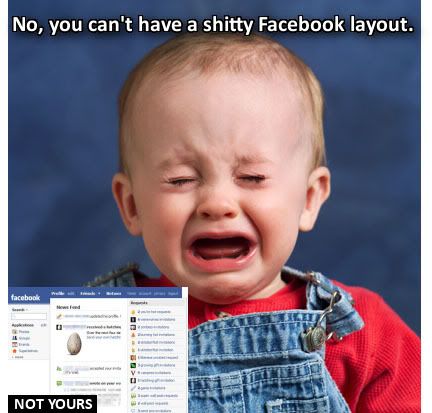
There's been a great deal of whining lately about the new Facebook layout, and more than a few Facebook groups dedicated to its eradication, but why all the hate? Since I have nothing better to do on this chilly Sunday afternoon, I'll take a stab at attempting to justify the new layout. It's very tldr, but try to bear with me. Besides, if you don't like reading you have no business being on the Internet in the first place.
I suppose the most simple answer for all the hate is because people fear change - and often with good reason: A new layout means that most non-tech savvy users (read: 90% of you) will have to spend time getting reacquainted with where to click in order to perform any given task.
In order to understand why the change came about in the first place, however, requires understanding the reasons that precipitated it. The fact of the matter is that Facebook was turning into a ridiculous parody of itself.
When I want to go to your profile to, for example, get your phone number or e-mail address, that's basically all I'm interested in. I couldn't give a fuck how many zombies you made, or how attractive your peers find you. Nor do I have any interest whatsoever in seeing the idiotic movie clips and ancient, dried up, "funny" images posted on your so-called Super Wall. As interesting and amusing as these applications may be to you, the ultimate truth is that nobody else gives a shit. So why should I get bombarded with your superfluous crap that steals my bandwidth, melts my CPU and crashes my browser, when all I want is your fucking e-mail address?
This is the same fate that befell MySpace when they decided to allow its users to customize their own profiles as they saw fit - the dreaded "MySpace Syndrome". 99% of profiles became so afflicted with hideous layouts, that when Facebook showed up, everybody jumped ship for the promise of a more sane social network.
Today, the only people who still regularly use MySpace are lonely 13-year-olds and out-of-touch record labels.
This is what Facebook was turning into because of people like you. Every second profile was becoming so overloaded with ridiculously stupid and unnecessary application boxes that they became nigh on unusable. If things were allowed to escalate, then those of us who are not complete and utter morons would have left to find another social network to call our own. Bebo or Orkut or maybe even one that doesn't suck. At least until you retards with your Pirates vs Vampires shit decided to seek us out yet again. No, the line must be drawn somewhere and that somewhere is here.
"But it's my profile, I can do whatever I want to it!" I hear you belch? Well, no it isn't. A Facebook profile is not public property. It's virtual, private property, and unless you paid money for your profile, you have exactly zero say over it. Furthermore, if you had read the Facebook Terms of Use before signing up (you didn't, am I right?), you'll know that everything that gets posted to Facebook becomes the property of Facebook and they can do with it pretty much whatever they want. Uploading all those pictures of little Billy's first steps doesn't seem like such a good idea anymore, now does it?
The new Facebook layout arranges everything into dynamic tabs. This means that the content of any given tab only gets downloaded when I click on that tab. And, fortunately, Facebook included a "bullshit" tab. Oh, I'm sorry, I meant to say "boxes" tab. This is where your Super Wall, Top Friends, and other assorted crap nobody cares about goes. This means that your applications can now be seen only by people who really want to see them (read: nobody).
Now, I'm all for choice. Some of you don't want the new layout gone permanently, you just want the option to go back to the old one. That's not too unreasonable, is it? Well, no it's not. Unfortunately, though, it's not gonna happen and here's why:
If Facebook decided to keep both the old and new layouts this means that, in future, whenever they wanted to add or extend functionality to the site they'll be severely hampered in doing so. Worst case scenario, it'll be impossible. Best case scenario, they'll have to do twice the amount of work. Which means twice the number of man-hours. Which means twice the expense. From a business point of view (and remember Facebook is a business, not a public service - they don't owe you jack shit) having two concurrent layouts is completely unfeasible.
What this means is that there can be only one layout. Shouldn't it be the better, more evolved of the two options? The one that's more convenient to use, overall less threatening to Facebook's revenue stream and, let's face it, less embarrassing.
Ultimately, if you don't like it you're free to join another social network. I recommend MySpace where you'll be free to show off your Zombies and Top Friends with all the lonely 13-year-olds and out-of-touch record labels. They just love that shit.
Thursday, September 11, 2008
Brown Ubuntu: It's not that bad, really!
Ubuntu has taken quite a bit of flack from the get go for its, uhm... unique... default colour scheme; mostly because the overarching colour of the theme is brown. Now, I myself am quite partial to it. It's warm, welcoming, and a departure from the same old blue- and silver-based themes with which most other operating systems seem to roll off the assembly line. This default theme has been tweaked throughout Ubuntu's various releases, but the main colour palette still remains based around the colour brown.
 My current (at time of writing) Ubuntu Linux desktop.
I've thus far been rather indifferent to this particularly nasty brand of prejudice... Until it made its way onto my own doorstep. Judging me by the colour of my skin is one thing, but judging me by the colour of my desktop? Well, I'm afraid that's just going too far.
A sagacious relative of mine bombasted his corpulent cuerpo into my bedroom on a recent visit, and spied my Ubuntu desktop (sporting a modified, but still very much brown, theme). The first words echoing from out of his abysmal estuary described my desktop as "looking like shit." Not in a metaphorical sense, mind you, but in a very literal, faecal one. I shrugged it off and distracted him by tossing an animal cracker down the hall. Nevertheless, this got me thinking. Why would the first thing someone thinks of, when seeing the colour brown, be shit? There's nothing inherently shitty about the colour brown - though, I concede, there's something inherently brown about shit.
When I think of the colour brown, the first thing that pops into my head is chocolate. Something which is a treat: A delicious luxury to be sampled only by the most deserving. Wouldn't this be a very clever - or at least marketable - way to describe a great operating system? Think of a high quality, free operating system as being analogous to a neverending river of chocolate. The former being as much a pleasure to use as the latter is to eat. Except that Ubuntu won't cause you to get fat (in theory). Nor cause you to become diabetic and lead you to a lifetime of health problems and an early death. Okay, come to think of it, maybe chocolate isn't such a marketable analogy, but hey, at least it's not shit.
Another thing that comes to mind when I think of the colour brown is coffee. A delicious beverage with a history as rich as its flavour, and with as many varieties as it has fans; one for every palate. A universally beloved infusion which is welcoming enough to be accessible to the casual drinker, yet still full and complex enough to please the connoisseur. A drink equally at home and appropriate in a professional atmosphere as in a casual one, a pot of which not being out of place in either a cosy room with a few close friends, or the boardroom of a Fortune 500 company.
Wouldn't that last paragraph, awkward though it may be, describe Linux with equal comeliness? Of course it would, because it does.
What it comes down to is that those who attack Ubuntu for adopting a brown default theme for their Linux distribution are really just highlighting their own short-sightedness. Clearly, they feel the need to beset those who dare deviate from the norm of cold, sparse themes which are about as homely as an operating theater.
Your choice of themes, much like your choice of sexual partner, is an individual thing and entirely your own business, but it seems irrational to attack Ubuntu for using a brown default theme, given its warmth, neutrality and individuality.
Mark Shuttleworth has written a great defense of the choice of brown for the default Ubuntu theme, clearly explaining the motivation.
As requested, here's a link to the GTK Dust theme.
My current (at time of writing) Ubuntu Linux desktop.A sagacious relative of mine bombasted his corpulent cuerpo into my bedroom on a recent visit, and spied my Ubuntu desktop (sporting a modified, but still very much brown, theme). The first words echoing from out of his abysmal estuary described my desktop as "looking like shit." Not in a metaphorical sense, mind you, but in a very literal, faecal one. I shrugged it off and distracted him by tossing an animal cracker down the hall. Nevertheless, this got me thinking. Why would the first thing someone thinks of, when seeing the colour brown, be shit? There's nothing inherently shitty about the colour brown - though, I concede, there's something inherently brown about shit.
When I think of the colour brown, the first thing that pops into my head is chocolate. Something which is a treat: A delicious luxury to be sampled only by the most deserving. Wouldn't this be a very clever - or at least marketable - way to describe a great operating system? Think of a high quality, free operating system as being analogous to a neverending river of chocolate. The former being as much a pleasure to use as the latter is to eat. Except that Ubuntu won't cause you to get fat (in theory). Nor cause you to become diabetic and lead you to a lifetime of health problems and an early death. Okay, come to think of it, maybe chocolate isn't such a marketable analogy, but hey, at least it's not shit.
Another thing that comes to mind when I think of the colour brown is coffee. A delicious beverage with a history as rich as its flavour, and with as many varieties as it has fans; one for every palate. A universally beloved infusion which is welcoming enough to be accessible to the casual drinker, yet still full and complex enough to please the connoisseur. A drink equally at home and appropriate in a professional atmosphere as in a casual one, a pot of which not being out of place in either a cosy room with a few close friends, or the boardroom of a Fortune 500 company.
Wouldn't that last paragraph, awkward though it may be, describe Linux with equal comeliness? Of course it would, because it does.
What it comes down to is that those who attack Ubuntu for adopting a brown default theme for their Linux distribution are really just highlighting their own short-sightedness. Clearly, they feel the need to beset those who dare deviate from the norm of cold, sparse themes which are about as homely as an operating theater.
Your choice of themes, much like your choice of sexual partner, is an individual thing and entirely your own business, but it seems irrational to attack Ubuntu for using a brown default theme, given its warmth, neutrality and individuality.
Mark Shuttleworth has written a great defense of the choice of brown for the default Ubuntu theme, clearly explaining the motivation.
As requested, here's a link to the GTK Dust theme.
Subscribe to:
Posts (Atom)